
Butts County Court Records After Arrest
A Butts County jail arrest creates more than one kind of record. The booking side belongs to the sheriff and jail. It can show intake, custody, release, a booking photo if releasable, and the arrest charges entered at intake. The court side belongs to the clerk and the court. It shows what was actually filed in the case, what changed after filing, and how each count ended.
The path is usually arrest, booking, first appearance, prosecutor review, formal filing, and then case events. The Butts County Clerk of Court is the local access point for court case records. The Towaliga Judicial Circuit District Attorney is the prosecutor for Butts County felony cases and is the office that helps decide how charges are filed after law enforcement submits reports and evidence.
Booking charges are useful, but they are not the final word. A jail entry can start with one label, while the prosecutor files a different count, seeks an indictment, reduces a count, or declines to proceed. For custody and booking status, use Butts County jail inmate records. For booking photos, use Butts County jail mugshots. For court records after a jail arrest, start with the clerk and the filed case.
Find Butts County Court Case Records
The clerk case-search route is the best first stop once a Butts County arrest has moved into court. Search by name if no case number is known. Use the case number when it appears on a bond paper, citation, warrant, or clerk notice because common names can return more than one record. If a case is too new, the booking may exist before the formal court entry appears.
The clerk site is a local source for Butts County court records. The GSCCCA clerk listing for Butts County is also useful for confirming the official clerk route. Some early warrant or magistrate matters may route through magistrate channels, but the research did not confirm Butts County as a searchable participating warrant court in the statewide magistrate portal.
The Butts Clerk website is the source shown in the manifest for local court access.
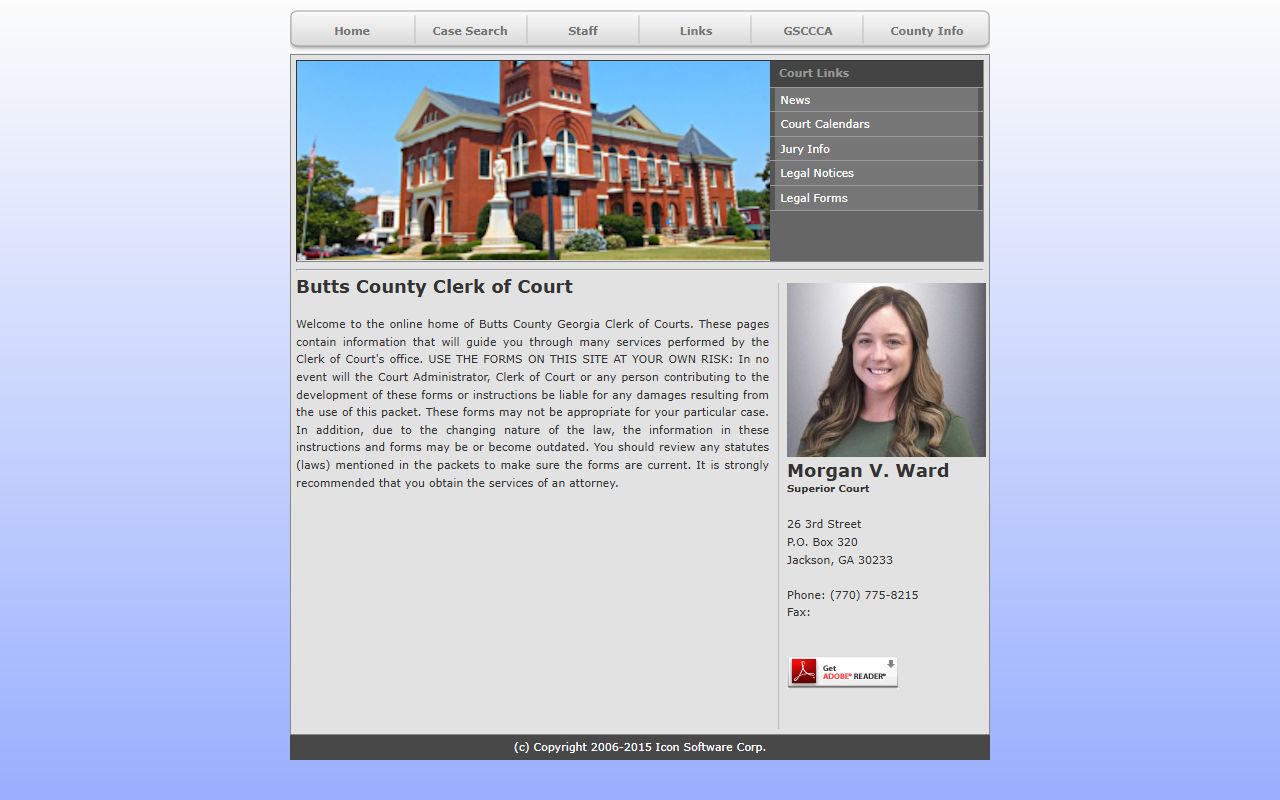
This clerk page matters because court charges, hearings, dispositions, and sentence entries are clerk records, not jail roster entries.
| Search Field | Type | Use | Notes |
|---|---|---|---|
| Defendant or party name | Text | Likely optional | Use last name and first name. Exact vendor fields may appear after the clerk search link. |
| Case number | Text | Optional | Best when copied from court paperwork, a warrant, a citation, or a jail record. |
| Date range | Date | Optional | Helpful for recent arrests and common names. |
| Court or case type | Filter | Optional | May include criminal, civil, traffic, probate, or other case groups depending on the vendor. |
| Search or submit | Button | Required action | The exact button label depends on the live case-search vendor. |
Note: A same-day booking may not appear in the court index until the prosecutor or clerk has filing data to enter.
Charging Documents After Butts County Arrest
A charging document is the paper or electronic filing that turns an accusation into a court case. In Butts County court records after a jail arrest, this is the point where the formal case can begin to differ from the jail booking line. The document may be tied to a warrant, an accusation filed by the prosecutor, or an indictment returned by a grand jury.
The research identifies accusation and indictment as key Georgia filing paths, with magistrate court involved in some early warrant, first-appearance, or bond functions. The exact document depends on the charge level, the court, and the prosecutor's choice under Georgia procedure.
| Document | Who Uses It | What It Does | Why It Matters |
|---|---|---|---|
| Warrant or complaint record | Law enforcement, magistrate, or court staff | Starts or supports the arrest and early court review. | It may explain why the person was booked or held. |
| Accusation | Prosecutor | Files formal charges without a grand-jury indictment where allowed. | It can be the court's main charging document in the case file. |
| Indictment | Grand jury | Returns formal felony charges after prosecutor presentation. | It may replace, refine, or expand earlier arrest charges. |
Butts County Charge Status Records
Charge status is the case's current posture. A pending count is still open. An amended charge has changed. A reduced charge has been lowered to a lesser offense. A dismissed charge ended without a conviction. A nolle prosequi entry means the prosecutor declined to keep going on that charge.
Read each count on its own. One Butts County court record can include several counts with different outcomes. A person may have one charge dismissed, another reduced, and another resolved by plea. The court record should be read by count, date, and disposition instead of by the arrest headline alone.
| Status | Meaning | Practical Reading |
|---|---|---|
| Pending | The charge is still open. | Look for the next hearing, bond order, or filing deadline. |
| Accusation | The prosecutor filed a formal charging document. | The court file now has charges separate from the jail booking entry. |
| Indictment | A grand jury returned formal charges. | The indictment may define the felony counts going forward. |
| Amended or reduced | The filed charge changed. | Compare the newest count to the original arrest or accusation. |
| Dismissed | The charge ended without conviction. | Check whether all counts ended or only one count was dismissed. |
| Nolle prosequi | The prosecutor chose not to proceed. | This is a prosecutor action, not the same as an acquittal after trial. |
| Plea or conviction | The person was adjudicated guilty or entered a plea accepted by the court. | Look for sentence, probation, jail credit, or prison transfer entries. |
DA Review After Butts County Arrest
The Towaliga Judicial Circuit District Attorney serves Butts County. After a jail arrest, law enforcement submits reports and evidence. The DA then determines whether to file charges, which counts to file, and whether a felony case should proceed by accusation, indictment, or another route allowed by Georgia practice.
That prosecutor review explains why court records after a Butts County arrest may not match the first jail entry. A booking charge may be changed after more evidence is reviewed. A warrant may lead to a different filed count. The DA may dismiss or decline a count. Those decisions belong in the court file, while custody and release details remain with the jail.
The Towaliga District Attorney contact page is the official route for prosecutor contact information.

The DA site supports the prosecution side of the arrest-to-case path, while the clerk site supports filed court-record access.
Bond and Warrant Court Records
Bond may be addressed at first appearance or changed later by the court. Georgia release paths include cash bond, surety bond, property bond, and personal-recognizance release where the judge allows it. A no-bond hold or detainer can still block release even when one charge lists a bond amount. For same-day custody and bond status, the Butts County Jail number in the research is 770-775-8216.
Warrants can also shape the court record after a jail arrest. An arrest warrant authorizes custody. A bench warrant can follow a missed court date. A fugitive or out-of-county warrant can create a hold. No official Butts County public warrant-search page was located in accessible county or sheriff materials, so warrant research should use the jail phone, the clerk, magistrate contact where relevant, and an open-records request when the record is public.
- Detainer
- A notice or hold from another agency that can delay release.
- First appearance
- An early court hearing where rights, charges, and bond may be addressed.
- Remand
- A court order sending a person back to custody.
- Personal-recognizance bond
- Release based on a written promise and court conditions instead of full cash payment.
Note: Call before going to the jail to post bond because accepted payment methods were not published in accessible official jail materials.
Charge vs Conviction Records
A charge is an allegation. A conviction is a court result. That distinction is vital when reading Butts County court records after arrest because a case file may show old charges, replaced charges, and final dispositions in the same record. Do not treat a booking label or pending court count as proof that the person was convicted.
| Point of Comparison | Charge | Conviction |
|---|---|---|
| Stage | Arrest, accusation, indictment, or pending count. | Final guilty finding, accepted plea, or adjudication. |
| Proof level | Based on probable cause or prosecutor filing. | Requires a plea or proof accepted by the court. |
| Record meaning | Shows what was alleged or filed. | Shows the outcome and sentence if one was imposed. |
| Common mistake | Assuming a listed charge is final. | Missing dismissed or reduced counts that changed the case. |
Sealed vs Expunged Court Records
Georgia research points to record restriction under O.C.G.A. 35-3-37 as the main criminal-history access concept. Many people use the word expunged to mean hidden from ordinary public view, but Georgia procedures should be checked through the GBI and the court for the exact remedy. A restricted record is not the same thing as erasing every court, jail, or agency copy.
Open-records exemptions under O.C.G.A. 50-18-72 may also limit access to juvenile, medical, safety, privacy, or active investigative materials. The Georgia Attorney General open government page and the AG Blue Book are the official public-access-law references identified in the research.
| Point of Comparison | Sealed or Restricted | Expunged |
|---|---|---|
| Public visibility | Limited from ordinary public access when law allows. | Often used to mean removed or treated as unavailable, but exact meaning depends on law. |
| Georgia wording | Research identifies record restriction through GBI and O.C.G.A. 35-3-37. | Do not assume total deletion without a court or GBI route. |
| Who may still see it | Some justice agencies may retain lawful access. | Access depends on the specific order and statute. |
| Next step | Ask the clerk, GBI, or an attorney about eligible restriction. | Get the exact court order or agency instruction before relying on the term. |
State Records After Butts County Arrest
Court files and statewide criminal histories serve different needs. The clerk case file shows pleadings, charges, hearings, orders, and dispositions for the court case. The GBI criminal-history route is the statewide path for Georgia criminal-history record information and is governed by O.C.G.A. 35-3-34 and related rules.
Use the Georgia Magistrate Court Records portal only with care. It is a participating-court portal, and Butts County participation for searchable warrant records was not confirmed in the research. If it does not return a Butts County matter, that does not prove no warrant or court record exists.
The manifest captured the Georgia Magistrate Court Records portal as a statewide reference point.
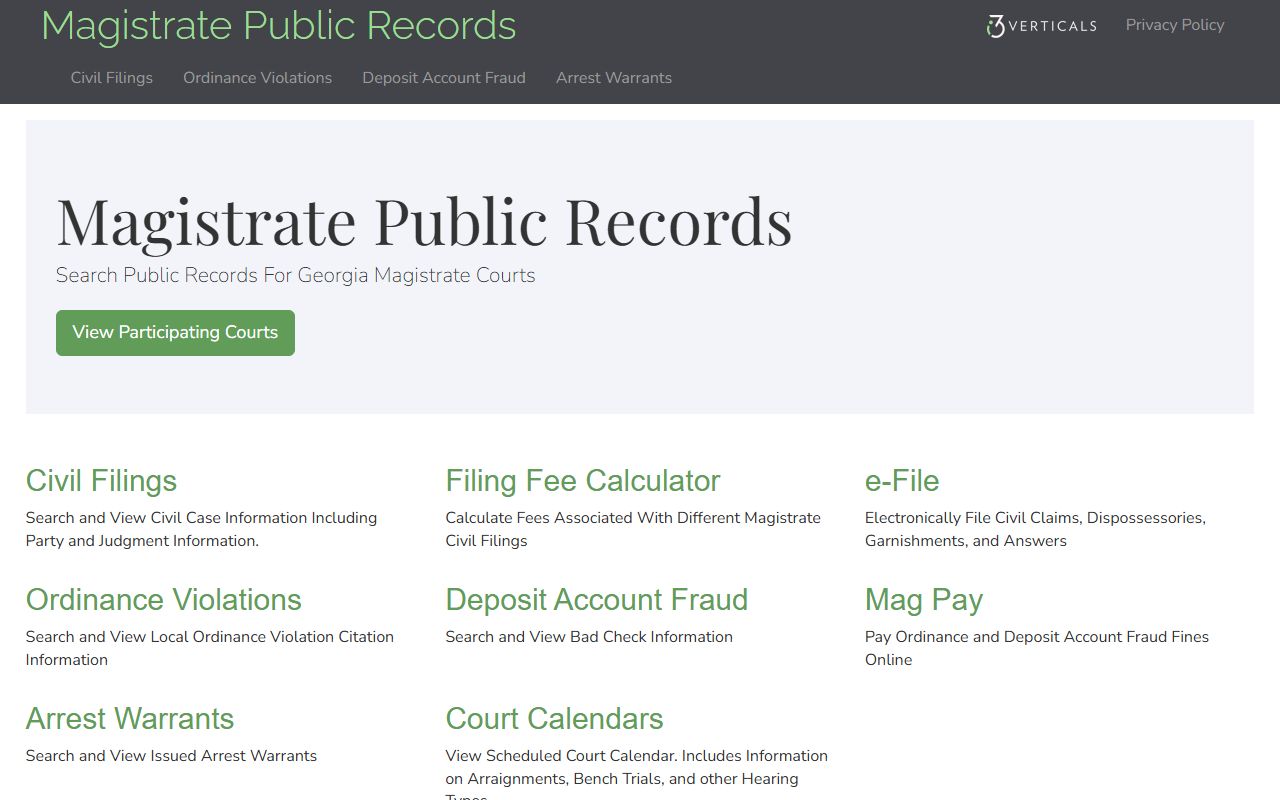
Use that portal as a possible court-search channel, then fall back to the Butts clerk or issuing court when local participation is unclear.
Request Older Butts County Records
If an online search fails, split the request by custodian. Ask the clerk for the criminal case file, filed charges, docket entries, orders, and dispositions. Ask the sheriff or jail for booking records, jail logs, booking photos if releasable, and release or transfer details. One office may not hold the other office's records.
Butts County maintains an open-records request page and Form 140. Georgia's Open Records Act, including O.C.G.A. 50-18-70 through 50-18-72, creates an access route but also permits lawful fees, redactions, and exemptions. Agencies generally must respond within three business days by producing records or stating when and at what cost records will be available.
The Butts County open-records page is the local fallback when the online court or jail path does not give enough detail.